


Why Do Communities Create Relationship Terms Before Research Exists?

In emerging areas of human behavior, communities often name experiences before researchers study them.
People create language when they encounter relationship dynamics that feel new or confusing. These words spread through conversations, forums, podcasts, and writing communities. Over time, the terms begin to function as widely accepted concepts. Familiar language can lead people to assume scholars have already studied the phenomenon. In reality, many of these terms originate from lived experience within social groups.
This pattern has occurred repeatedly in the development of polyamory discourse over the past several decades. As consensual non-monogamy becomes more visible in public conversation, communities develop new language to describe their experiences. Traditional monogamous frameworks rarely required terms for many of these relational dynamics.
The emergence of new terminology is not inherently problematic. In many cases community language identifies meaningful relational experiences that have not yet attracted scholarly attention. However, when language spreads rapidly through online culture, the distinction between descriptive shorthand and theoretical explanation can become blurred. This dynamic creates a challenging landscape for anyone attempting to discuss relationships with intellectual precision.
At Modern Polyamory, we could easily join this cycle by inventing new terms for every relational pattern. A writer might introduce catchy labels for relationship dynamics. Social media could rapidly circulate those ideas across discussion spaces.
Yet generating terminology without careful analysis ultimately risks obscuring rather than clarifying the relational processes people are trying to understand. When too many loosely defined concepts accumulate, it becomes increasingly difficult to distinguish between community narratives and research-informed insights.
One phrase that illustrates this tension particularly well is Polyamory Under Duress.
What Does the Term Polyamory Under Duress Actually Mean?
People most commonly use the phrase Polyamory Under Duress to describe a situation in which one partner agrees to non-monogamy even though they prefer monogamy, typically because they fear losing the relationship if they refuse. Within discussions of ethical non-monogamy, many community members frame this scenario as ethically troubling because it appears to undermine the principle of enthusiastic consent. Polyamorous relationships frequently emphasize communication, negotiated agreements, and the autonomy of each participant. When a partner feels pressured to accept a relationship structure they do not truly want, observers may interpret the situation as a violation of those ideals.
From this perspective, the phrase functions as a warning about the ethical boundaries of relationship negotiation. It signals that the transition from monogamy to non-monogamy may sometimes involve emotional pressure that complicates the idea of freely given consent. For individuals experiencing that pressure, the emotional reality can be intense. Feelings of insecurity, fear of abandonment, and uncertainty about relational stability may accompany the negotiation process.
At the same time, many people use the phrase in ways that reduce a complex interpersonal dynamic to an overly simple explanation.Relationships frequently involve moments in which partners discover fundamental differences in their preferences, expectations, or identities. These differences may concern sexuality, lifestyle choices, religious beliefs, or long-term goals. The emergence of such disagreements does not automatically indicate coercion. In many cases it simply reveals that two people are attempting to navigate a profound relational mismatch.
This raises an important analytical question. When someone reluctantly agrees to try polyamory, does coercion drive that decision, or does the person engage in a negotiation aimed at preserving a valued relationship? The distinction is not always easy to draw, and the phrase Polyamory Under Duress sometimes collapses these different possibilities into a single narrative.
Where Did the Idea of Polyamory Under Duress Come From?
Through his Savage Love column and podcast, Dan Savage popularized the phrase Polyamory Under Duress and helped shape public conversations about sexuality and relationships for decades.Savage introduced the term while discussing situations in which monogamous partners felt pressured to accept non-monogamy. In his commentary, Savage used the phrase to highlight situations where relationship transitions risk violating ethical boundaries.
Although Savage’s work has played an important role in public discussions of sexual ethics, it is important to recognize that the phrase did not originate within academic research. Instead, it emerged from advice discourse and community conversation. Like many concepts in relationship culture, the term spread quickly through blogs, podcasts, and social media discussions before scholars had an opportunity to formally examine the dynamics it described.
This pattern reflects a broader feature of how relationship language evolves. Cultural commentary often identifies relational tensions long before researchers begin studying them systematically. Advice writers, therapists, and community members observe patterns in their interactions and attempt to describe those patterns using accessible language. Over time those descriptions can become widely accepted frameworks for interpreting relationship experiences.
However, when a concept spreads through culture before scholars carefully define it, people may begin using the phrase as a catch-all explanation for several different phenomena. In the case of Polyamory Under Duress, the term sometimes refers to genuine coercion, sometimes to reluctant compromise, and sometimes to structural tensions within relationship networks. Without clear definitions, people often struggle to determine which situation a conversation actually refers to.
What Does Relationship Science Say About Relational Mismatches?
Although polyamory itself has only recently become a focus of academic research, relationship science has long examined how couples navigate differences in their desires, expectations, and life goals. Long-term partnerships frequently involve negotiation around issues that are deeply meaningful to both individuals. Disagreements may arise around topics such as sexual desire, parenting decisions, career paths, financial priorities, or religious commitments.
Research on commitment provides insight into why people remain in relationships despite these differences. One influential framework is the Investment Model of Commitment, developed by Caryl Rusbult. According to this model, individuals remain committed to relationships based on a combination of factors including satisfaction with the relationship, the investments they have already made in it, and the perceived availability of alternative partners. When investments are high and alternatives appear limited, people may attempt to resolve relational mismatches rather than ending the relationship.
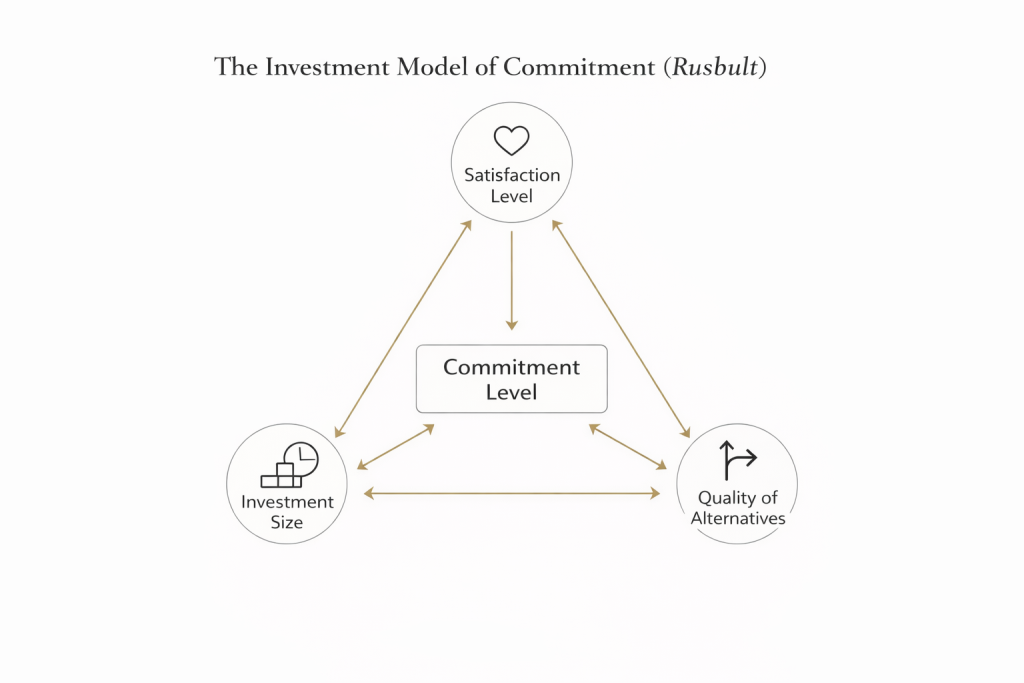
These dynamics suggest that relational compromise is not unusual. Couples often attempt to negotiate differences in ways that preserve the relationship while accommodating each partner’s needs as much as possible. Some negotiations succeed and lead to new relational arrangements. Others reveal incompatibilities that eventually lead partners to separate.
From this perspective, disagreement about relationship structure may be one instance of a broader phenomenon. Rather than representing a unique form of relational coercion, the conflict may reflect the same negotiation processes that occur in many other areas of partnership.
Why Isn’t There Also a Concept Called Monogamy Under Duress?
If Polyamory Under Duress refers to situations in which someone tolerates non-monogamy in order to preserve a relationship, an interesting inverse question emerges. Why have scholars and commentators not developed a widely recognized concept to describe the opposite scenario?
Many individuals who feel drawn to non-monogamy remain in monogamous relationships because they value their partner and do not want to risk losing the relationship. In these cases the compromise moves in the opposite direction. Instead of tolerating polyamory despite discomfort, someone may tolerate monogamy even though they feel that monogamy constrains their relational autonomy.
From a structural perspective, the dynamics are strikingly similar. In both situations a person suppresses a relational preference in order to maintain a meaningful emotional bond. The difference lies primarily in which relationship structure a culture treats as the default.
Many societies assume monogamy as the baseline expectation for romantic relationships. When a couple remains monogamous despite one partner’s interest in non-monogamy, observers may interpret the compromise as ordinary relationship maintenance. When polyamory enters the conversation, however, the shift away from the default structure becomes more visible and emotionally charged.
Recognizing this asymmetry does not diminish the importance of addressing genuine coercion. Rather, it highlights how cultural assumptions shape which relational compromises people view as problematic. The deeper phenomenon may not involve polyamory specifically, but rather the difficulty of negotiating incompatible visions of intimacy within an ongoing relationship.
What Different Situations Get Labeled Polyamory Under Duress?
Examination of community discourse shows that Polyamory Under Duress often functions as a broad umbrella for several distinct relational dynamics. These situations differ significantly in terms of ethical implications and emotional consequences.
Common scenarios described using the term include:
• Genuine coercion, in which one partner pressures the other through manipulation, ultimatums, or dismissal of their boundaries.
• Reluctant compromise, in which a partner agrees to try polyamory despite uncertainty because they value the relationship and hope the arrangement might succeed.
• Structural pressure on additional partners, where established couples create conditions that make it difficult for new partners to maintain stable or equitable relationships.
Because people frequently apply the same phrase to several different dynamics, conversations about Polyamory Under Duress can become confusing. When discussions do not distinguish between these situations, people struggle to determine whether the underlying issue involves coercion, incompatibility, or systemic power imbalance.
How Can Future Research Improve Our Understanding?
The conversation surrounding Polyamory Under Duress highlights several areas where additional research would be valuable. As the academic study of consensual non-monogamy continues to expand, scholars may begin examining how couples navigate transitions between different relationship structures.
Future research could explore questions such as:
• How frequently reluctant transitions into polyamory occur.
• Which psychological or relational factors predict whether those transitions succeed or fail.
• How power dynamics within established couples affect new partners entering the relationship network.
• What communication strategies help partners negotiate disagreements about relationship structure.
Investigating these questions would allow researchers to move beyond anecdotal descriptions and develop a more precise understanding of how relational mismatches unfold.
What Does Polyamory Under Duress Really Tell Us About Relationships?
The phrase Polyamory Under Duress has become a powerful shorthand within discussions of ethical non-monogamy. It captures the emotional tension that can arise when partners discover that they want different relationship structures. For many individuals, the term provides language for experiences that feel destabilizing and difficult to navigate.
At the same time, the phrase may obscure the complexity of the dynamics involved. Rather than describing a single phenomenon, the concept often refers to several different relational situations involving coercion, negotiation, and incompatibility. Recognizing those distinctions allows for a more nuanced understanding of the challenges couples face when their visions of intimacy diverge.
Ultimately, the conversation about Polyamory Under Duress may reveal something fundamental about human relationships. People frequently attempt to preserve meaningful bonds even when their desires and identities evolve in different directions. Navigating those moments requires honesty, compassion, and a willingness to confront difficult truths about compatibility.
Sometimes the hardest realization in a relationship is recognizing that neither pressure nor betrayal occurred.
Sometimes it is simply the discovery that two people want different kinds of love.