



Maybe you are fresh out of a breakup. You are not looking for anything serious yet, but curiosity gets the better of you and you download a few dating apps just to see what is out there. As you scroll through profiles, you start noticing something unfamiliar. A surprising number of people include the letters ENM in their bio. Sometimes it appears alongside words like poly, open relationship, or partnered but dating. Other times it is just those three letters sitting there like an inside joke everyone understands except you.
You pause for a moment and wonder: What does ENM actually mean?
If you have found yourself asking this question, you are not alone. Over the past decade, conversations about different ways of organizing relationships have become more visible. Dating apps, podcasts, online communities, and relationship educators have introduced many people to a term that was once mostly used in academic research: ethical non-monogamy.
At its simplest, ethical non-monogamy describes relationships in which people openly and consensually have more than one romantic or sexual partner.
That sentence sounds straightforward, but the reality is much more complex. Ethical non-monogamy is not one specific type of relationship. Instead, it is a broad umbrella that includes many different ways people structure intimacy, commitment, and connection.
Understanding that umbrella is often the first step toward understanding polyamory.
The Ethical Non-Monogamy Umbrella
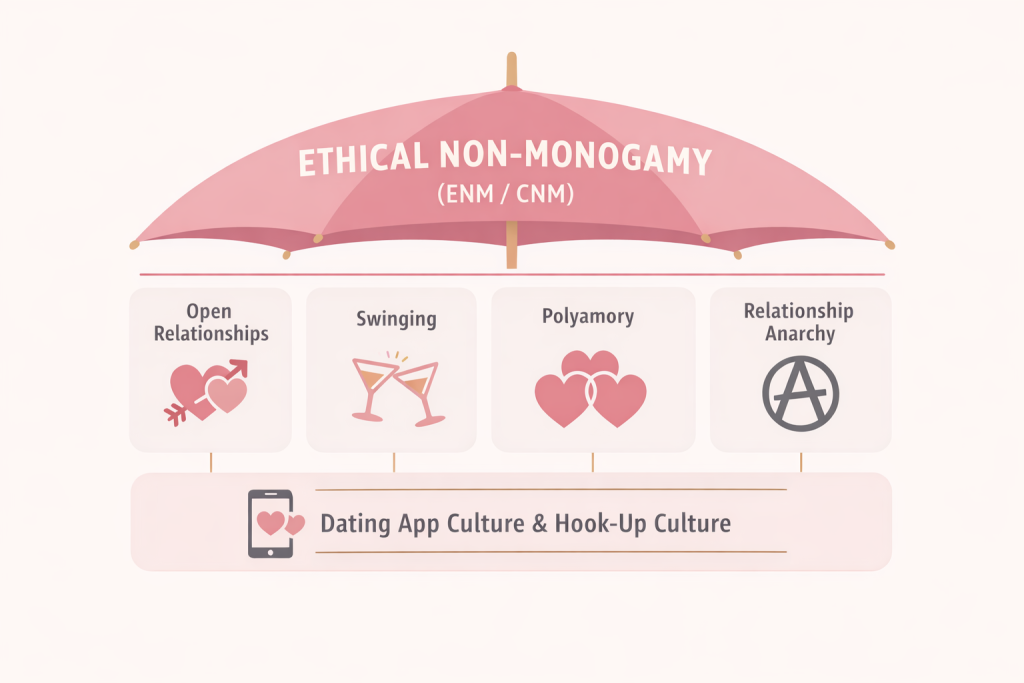
Ethical non-monogamy is best understood as an umbrella category that includes multiple relationship styles built around consent, communication, and transparency. These styles vary widely in how people organize romance, sexuality, autonomy, and community.
Some relationship structures emphasize long-term emotional partnerships. Others focus on sexual exploration or social experiences. Still others emphasize personal autonomy and the freedom to let relationships develop organically.
The most commonly recognized forms of ethical non-monogamy include:
• open relationships
• swinging
• polyamory
• relationship anarchy
• hook-up and dating app culture
Each of these approaches represents a different way of navigating intimacy outside traditional monogamy.
Open Relationships
An open relationship typically begins with a committed couple who agree that one or both partners may pursue sexual connections outside the primary relationship.
In many open relationships, the central partnership remains the primary romantic bond while outside relationships may be casual, ongoing, or occasionally recurring. Couples often negotiate boundaries around communication, safer sex practices, and how much information they share about outside partners.
Common characteristics of open relationships include:
• a central romantic partnership
• independent sexual connections outside the relationship
• negotiated agreements about boundaries
• communication about emotional expectations
For many people exploring ethical non-monogamy, open relationships serve as a first step away from strict monogamy while maintaining a familiar partnership structure.
Swinging
Swinging is a form of consensual non-monogamy in which couples engage in sexual experiences with other people, usually together.
Communities often organize around social environments such as clubs, private events, and gatherings where couples meet others with similar interests. Unlike polyamory, swinging generally focuses on sexual exploration rather than developing additional romantic relationships.
Common features of swinging include:
• couples participating together
• social events or community gatherings
• a focus on sexual experience rather than romantic attachment
• well-established etiquette and consent norms
Swinging communities have existed for decades and have developed their own cultural expectations around communication, boundaries, and respectful behavior.
Polyamory
Polyamory refers to the practice of having multiple romantic relationships simultaneously with the knowledge and consent of everyone involved.
While other forms of non-monogamy may focus primarily on sexual experiences, polyamory emphasizes the possibility that people can form meaningful emotional and romantic connections with more than one partner.
Polyamorous relationships can take many forms depending on how people structure their connections.
Common structures include:
• V relationships – one person connects two partners who are not romantically involved with each other
• Triads – three people who are all romantically involved together
• Polycule networks – interconnected relationship systems that resemble social networks rather than traditional couples
• Parallel polyamory – partners have limited interaction with each other
• Kitchen table polyamory – partners and metamours are comfortable socializing together
Polyamory is less about a specific structure and more about the willingness to develop multiple consensual romantic relationships.
If you would like to explore the dynamics of polyamory in greater depth, you can read our full guide here:
Hook-Up Culture
Modern dating culture has introduced another environment where people engage in multiple relationships simultaneously, often without recognizing that these dynamics overlap with ethical non-monogamy.
Dating apps frequently encourage individuals to talk to, date, and sometimes sleep with multiple people before deciding whether to become exclusive. Casual relationships, friends-with-benefits arrangements, and situationships have become common parts of the dating landscape.
How Dating Apps Normalize Non-Monogamy
Many dating platforms are designed around the assumption that users will explore multiple connections before choosing a partner. As a result, it is common for people to interact with several potential partners at once.
These dynamics often involve:
• seeing multiple people at the same time
• casual sexual connections without exclusivity
• evolving relationships that may or may not become committed partnerships
• communication about whether exclusivity has been established
The Overlap With Ethical Non-Monogamy
From a structural perspective, these behaviors closely resemble forms of non-monogamy. The key difference is that ethical non-monogamy communities emphasize intentional communication frameworks, while modern dating culture often leaves expectations undefined.
Research suggests that this type of relationship behavior is already widespread.
A frequently cited study by Halpern and colleagues (2017) found that approximately one in five adults report having participated in some form of consensual non-monogamy at some point in their lives.
However, that statistic only includes individuals who identify their experiences within research definitions of non-monogamy. If common dating practices such as multi-partner dating and casual hook-up culture were included in those definitions, the number of people engaging in non-monogamous relationship behavior would likely be significantly higher.
What Recent Data From Dating Apps Shows
Recent research from the dating app Feeld illustrates how common these patterns have become. Surveys conducted with nearly six thousand respondents found that a large majority of participants had used dating apps and many were actively exploring connections with multiple people simultaneously.
A notable portion of respondents described navigating relationship networks rather than traditional one-to-one dating, suggesting that many people are already practicing forms of non-monogamy in their dating lives, even if they do not use that language to describe their relationships.
This helps explain why ethical non-monogamy has become such a visible conversation in modern dating culture.
In many ways, ethical non-monogamy can be understood as a more intentional and communicative framework for relationship dynamics that already exist in contemporary dating culture
.
Relationship Anarchy
Relationship anarchy represents a philosophical approach to relationships that challenges traditional assumptions about how different types of relationships should be prioritized.
Rather than automatically placing romantic relationships above friendships or other forms of connection, relationship anarchists often emphasize autonomy, consent, and the idea that every relationship should be negotiated individually.
Some principles associated with relationship anarchy include:
• rejecting rigid relationship hierarchies
• allowing each relationship to develop organically
• valuing friendships and chosen family alongside romantic partners
• emphasizing personal autonomy and negotiated agreements
One reason this approach resonates with many people is that psychological research has consistently shown that novel experiences can increase relationship satisfaction. Shared novelty activates reward systems in the brain and can deepen emotional bonds between partners.
Because relationship anarchy encourages flexibility, curiosity, and relationship experimentation, some people find that it allows them to pursue new relational experiences that might not fit traditional relationship scripts.
However, relationship anarchy can also present challenges.
Without clearly defined structures, partners may have different expectations about emotional commitment, time investment, or communication. When these expectations are not discussed openly, misunderstandings can occur.
For some people, the freedom of relationship anarchy feels empowering. For others, the lack of predefined structure can feel uncertain or destabilizing.
Like many forms of ethical non-monogamy, the success of relationship anarchy often depends on clear communication, emotional maturity, and strong interpersonal boundaries.
The Core Principles of Ethical Non-Monogamy
Despite the wide variety of relationship styles that fall under ethical non-monogamy, several core principles remain consistent. Whether someone is practicing polyamory, participating in an open relationship, navigating dating app culture, or experimenting with relationship anarchy, the health of the relationship dynamic depends less on the structure itself and more on the quality of the agreements between the people involved.
Healthy non-monogamous relationships typically rely on several foundational principles.
Informed Consent
Everyone involved understands the nature of the relationship structure and agrees to participate in it. Consent is ongoing and can be renegotiated as relationships evolve.
In ethical non-monogamy, consent is not a single conversation. It is a continuing process that requires partners to communicate openly about changing needs, new partners, and shifting relationship expectations.
Transparent Communication
Partners discuss expectations, desires, and concerns openly rather than relying on assumptions. Clear communication helps prevent misunderstandings and builds trust within relationship networks.
Because multiple relationships may exist simultaneously, communication becomes one of the most important skills in non-monogamous relationships. Honest conversations about feelings, time commitments, and boundaries allow partners to maintain trust and emotional safety.
Negotiated Boundaries
Healthy relationships include conversations about emotional needs, sexual health practices, time management, and relational expectations.
Boundaries are not rigid rules imposed on others. Instead, they function as agreements that help partners navigate complex relationship dynamics while respecting everyone’s comfort and wellbeing.
Emotional Accountability
Individuals take responsibility for their feelings, reactions, and behavior within the relationship. Rather than blaming partners for emotional discomfort, healthy non-monogamous relationships encourage reflection, growth, and self-awareness.
Jealousy, insecurity, and vulnerability can arise in any relationship structure. Ethical non-monogamy encourages people to address these emotions through communication and personal reflection rather than control or secrecy.
Respect for Personal Autonomy
Each person maintains agency over their own body, relationships, and life decisions. Ethical non-monogamy recognizes that love and commitment do not require ownership or control over another person.
Autonomy allows individuals to build relationships based on mutual desire rather than obligation or restriction.
Why These Principles Matter
Together, these principles form the ethical foundation that allows non-monogamous relationships to function with honesty and care. Without them, multiple relationships simply become chaos. With them, relationship networks can develop in ways that are supportive, emotionally meaningful, and sustainable over time.
It is also important to recognize that these principles are not exclusive to non-monogamy. The same skills that sustain healthy polyamorous relationships are the skills that sustain healthy monogamous relationships as well. Communication, consent, emotional maturity, and mutual respect are universal ingredients of relationship success.
What ethical non-monogamy does differently is place these skills at the center of the relationship conversation. Instead of assuming that commitment automatically produces stability, non-monogamous relationships require people to actively design how their relationships will function.
For many people, this intentional approach becomes the most valuable lesson ethical non-monogamy has to offer. It invites people to move beyond inherited scripts about how relationships are supposed to work and instead build relationships that reflect their actual needs, values, and capacity for connection.
Understanding the core principles of ethical non-monogamy is not just about learning how alternative relationship structures operate. It is about recognizing that relationships, in all their forms, are most successful when they are built on honesty, consent, and thoughtful care for the people involved.
And that principle holds true whether a person chooses monogamy, polyamory, or any relationship style in between.