


The Sentence Everyone Says
Anyone who practices polyamory long enough eventually hears the same reaction when they describe their relationship structure.
“I could never do that. I’m too jealous.”
The statement often arrives with certainty, as though jealousy automatically disqualifies someone from exploring non-monogamy. Beneath that response sits a powerful cultural assumption: people who practice polyamory must somehow lack jealousy entirely.
Reality looks very different.
Jealousy appears in every relationship structure, including monogamous ones. What changes in polyamory is not the presence of jealousy but the way partners approach it. Traditional monogamous scripts often rely on exclusivity to minimize insecurity. Polyamory removes that structural safety net, which means partners must develop stronger skills around emotional awareness, communication, and reassurance.
Many people who explore polyamory discover that jealousy becomes less mysterious once they understand what it actually represents. Instead of functioning as a sign that something is wrong, jealousy often acts as a signal that an important emotional need deserves attention.
Understanding that signal can transform jealousy from a frightening emotion into an opportunity for deeper self-awareness and stronger relationships.
Where Does Jealousy Come From?
Jealousy rarely appears as a single, isolated feeling. In most cases it forms from a cluster of emotional reactions that occur simultaneously.
People who pause and examine jealousy more closely often discover that the experience contains several underlying emotions, including:
- Fear of abandonment
- Insecurity about being replaced
- Comparison with another partner
- Concern about losing attention or importance
- A desire for reassurance
- Anxiety about uncertainty in the relationship
Because jealousy contains multiple emotional signals, identifying the dominant one often provides valuable clarity. Someone who initially feels jealous may realize that the real concern involves reassurance, stability, or personal worth rather than the partner’s actions themselves.
Approaching jealousy with curiosity rather than shame often reveals important information about emotional needs and expectations.
How Our Interpretations Shape Jealousy
Events themselves rarely determine emotional reactions. The meaning people assign to those events plays an equally important role.
Psychologists describe this process through Cognitive Appraisal Theory, a framework developed by researchers such as Richard Lazarus. According to this theory, emotional responses emerge from the way individuals interpret situations rather than from the situations alone.
When something happens in a relationship, the mind typically evaluates it in two stages.
First, people ask whether the event threatens something that matters to them. Emotional intensity remains low if the situation appears harmless. If the situation appears threatening, the brain continues to a second stage.
During the second stage, the mind evaluates whether the person has the resources to cope with the situation. Strong emotional responses often appear when the situation feels threatening and the person feels uncertain about how to manage it.
This framework explains why two people can experience the same event and respond in completely different ways.
Imagine a partner going on a date with someone new. One person may interpret that situation as evidence that love expands and relationships can coexist. Another person may interpret the same event as a sign that they might be replaced.
The event itself remains unchanged. The interpretation shapes the emotional reaction.
Recognizing this interpretive process often helps people approach jealousy with curiosity rather than panic.
Who Is Responsible for Managing Jealousy?

A common misconception about jealousy suggests that the person experiencing it must manage the emotion entirely on their own. Healthy relationships rarely operate that way.
Jealousy often emerges within the context of a relationship system, which means addressing it effectively usually involves several layers of responsibility.
Individual responsibility involves developing emotional awareness and recognizing personal triggers. Someone who understands that inconsistent communication tends to create anxiety can express that need clearly rather than reacting impulsively.
Relational responsibility also plays an important role. Partners contribute to emotional safety through honesty, reassurance, and predictable communication. When relationship dynamics change, proactive conversation often prevents misunderstandings that might intensify jealousy.
A third layer involves structural responsibility. Relationship agreements, expectations around time, and clarity about boundaries influence how secure people feel within the relationship network. Ambiguity often fuels insecurity, while thoughtful structure creates stability.
When all three levels work together, jealousy becomes far easier to navigate.
When Should You Bring Jealousy Up With Your Partner?
Not every moment of jealousy requires immediate confrontation. Some situations benefit from direct conversation, while others require reflection first.
Certain circumstances clearly call for open communication. Broken agreements, secrecy, dishonesty, or ongoing feelings of neglect often indicate that something in the relationship structure needs attention.
Other situations may benefit from introspection before discussion. Emotional reactions sometimes emerge from past experiences, insecurities, or misunderstandings rather than a partner’s behavior.
Pausing to reflect can help clarify the real concern before beginning a conversation. Productive dialogue usually begins with curiosity rather than accusation.
When You Should Look Inward First
Self-reflection can often reveal the deeper meaning behind jealousy.
Questions that frequently provide insight include:
- What am I afraid of losing right now?
- Did a specific moment trigger this reaction?
- Does this feeling relate to my partner’s behavior or my own insecurity?
- What reassurance would help me feel safer?
- Does this reaction connect to past relationship experiences?
Developing the ability to ask these questions strengthens emotional awareness and supports healthier communication. Instead of treating jealousy as an emergency, partners can treat it as a signal that invites reflection.
Feelings That Are Often Mistaken for Jealousy
Many emotions get labeled as jealousy when something else actually drives the reaction.
Understanding the difference can dramatically change how people respond.
Insecurity
Feeling uncertain about personal worth in the relationship.
Fear of abandonment
Worry that a partner might eventually leave.
Comparison
Feeling inferior to another partner.
Lack of reassurance
Wanting confirmation that the relationship still holds importance.
Fear of missing out
Feeling uncomfortable when a partner enjoys experiences that do not include you.
Loss of control
Many people grow up believing exclusivity guarantees emotional security. When polyamory removes that expectation, uncertainty can feel overwhelming. In these cases the emotional reaction often reflects loss of control rather than jealousy itself.
Recognizing these distinctions helps people respond to the correct emotional need instead of reacting to a misunderstood one.
Attachment Styles and Jealousy
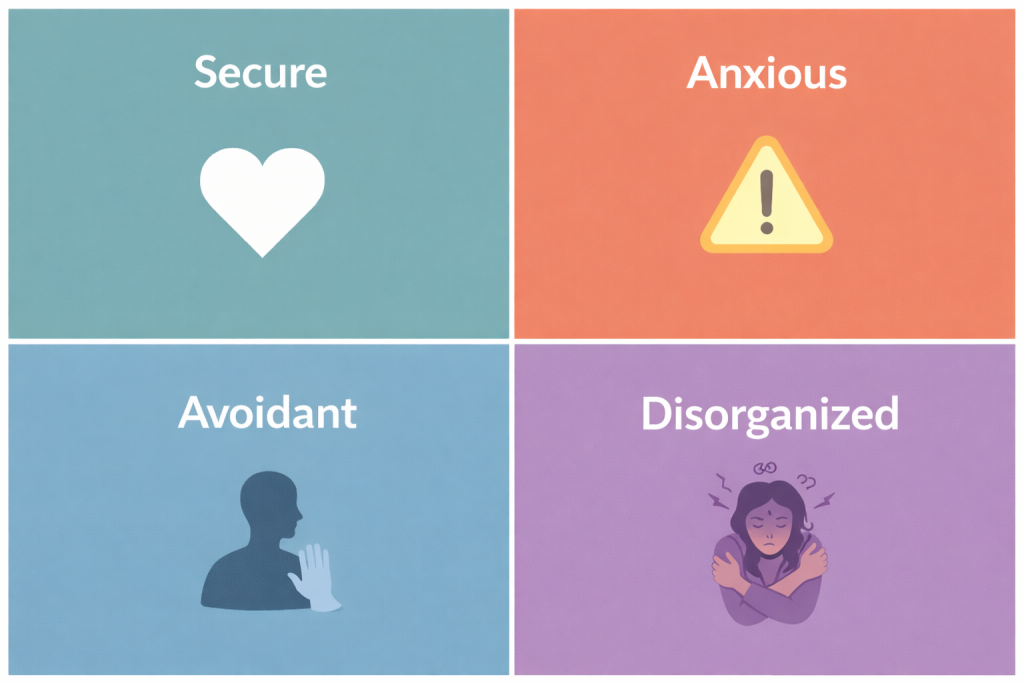
Early childhood relationships shape how individuals interpret emotional safety in adulthood. Psychologists describe these patterns through attachment theory, which explains how people learn to experience closeness, distance, reassurance, and vulnerability in relationships.
Attachment styles do not determine whether a relationship succeeds or fails. They do, however, influence how people interpret emotional signals such as jealousy.
Understanding these patterns often allows partners to respond to each other with greater empathy rather than frustration. If you are curious to find out your attachment style, you can take a quick 5 minute quiz.
Secure Attachment
Secure attachment often develops in environments where caregivers respond consistently to emotional needs. Children raised in these conditions learn that relationships can provide stability, comfort, and reliability.
Adults with secure attachment generally feel comfortable expressing emotions and trusting their partners. Conflict may still arise, but they often approach difficult conversations with curiosity instead of fear.
Jealousy can still appear in securely attached individuals, especially when relationship dynamics shift or uncertainty enters the picture. The difference lies in how they respond. Secure partners typically view jealousy as something to discuss rather than something to panic about.
Support for secure attachment tends to involve maintaining transparency and emotional openness. These individuals thrive when communication remains honest and expectations remain clear.
Anxious Attachment
Anxious attachment often develops in childhood environments where caregiving feels inconsistent or unpredictable. Emotional support may appear at times and disappear at others, leaving the child unsure whether their needs will be met.
Adults with anxious attachment often value closeness deeply. Relationships may feel intensely meaningful, and they often invest significant emotional energy into maintaining connection. At the same time, uncertainty can feel particularly threatening.
Because of this sensitivity, jealousy may appear quickly when something feels ambiguous. A delayed message, a change in plans, or the introduction of a new partner can activate fears of abandonment.
Despite these challenges, anxious attachment also carries strengths. These individuals often show deep empathy, emotional attentiveness, and strong dedication to their relationships.
Partners can support anxious attachment by offering consistent reassurance, communicating clearly about plans, and following through on commitments. Predictability often helps calm the nervous system and reduces jealousy responses.
Avoidant Attachment
Avoidant attachment sometimes develops in environments where caregivers discourage emotional dependence or emphasize independence very early in life. Vulnerability may feel uncomfortable because emotional closeness did not feel safe or necessary during childhood.
Adults with avoidant attachment often value autonomy and personal space. Many feel comfortable solving problems independently and may prefer to process emotions privately before discussing them.
In polyamorous relationships, this independence can sometimes function as a strength. Autonomy and personal agency often play important roles in non-monogamous structures.
However, jealousy can still emerge when emotional pressure increases or when partners expect vulnerability before trust has developed.
Individuals with avoidant attachment may respond to emotional intensity by withdrawing or minimizing the conversation. That reaction often reflects a learned strategy for managing emotional overwhelm rather than a lack of care.
Partners who want to support someone with avoidant attachment often succeed by respecting autonomy while gently inviting communication.
Disorganized Attachment
Disorganized attachment frequently emerges in childhood environments involving neglect, trauma, abuse, or unpredictable caregiving. In these circumstances caregivers may appear both comforting and frightening, which creates confusion about whether relationships provide safety or danger.
Adults with disorganized attachment may experience conflicting impulses toward closeness and distance. They may crave connection while simultaneously fearing vulnerability. Emotional situations can trigger strong reactions because the nervous system learned early that relationships can feel unpredictable.
Despite these challenges, disorganized attachment also carries powerful strengths. Individuals who have navigated difficult early experiences often develop deep emotional insight, strong empathy, and resilience.
When stability and emotional safety become consistent later in life, many individuals begin building secure relational patterns. That process often requires patience, self-awareness, and supportive partners.
Partners can help by maintaining consistency, communicating clearly during conflict, and reinforcing emotional safety. Calm reassurance and steady presence can help build trust that earlier experiences may have disrupted.
Trauma-Informed Communication in Relationships
Trauma-informed communication frequently appears in therapy settings, yet many of its principles translate beautifully into everyday relationship conversations. At its core, trauma-informed communication focuses on creating emotional environments where people feel safe enough to express vulnerability without fear of humiliation or abandonment.
Instead of treating difficult emotions as problems that must be solved immediately, trauma-informed communication encourages partners to approach conflict with patience, curiosity, and compassion.
Emotional Safety
Emotional safety allows difficult conversations to occur without escalating into defensiveness or blame. Partners who feel respected are far more likely to share their genuine experiences.
For example, a partner might say, “I noticed that I felt insecure when I realized I didn’t know much about your plans tonight,” rather than accusing their partner of causing jealousy.
This approach keeps the focus on emotional experience rather than personal attack.
Predictability
Predictability helps calm the nervous system. When people understand what to expect, uncertainty becomes less threatening.
Many couples create simple habits that increase predictability, such as sharing plans ahead of time or reconnecting after dates to talk about how the evening went. Small rituals of communication can reduce anxiety dramatically.
Curiosity Instead of Judgment
When emotions feel intense, people often assume they understand their partner’s motives. Trauma-informed communication encourages a different response.
Questions such as “What was that experience like for you?” or “Can you help me understand what you were feeling?” invite conversation rather than shutting it down.
Curiosity opens the door to empathy.
Regulation Before Resolution
Attempting to solve problems while emotions run high rarely produces healthy outcomes. When partners feel overwhelmed, taking a break often prevents conflict from escalating.
One partner might say, “I want to talk about this because it matters to me, but I feel a little overwhelmed right now. Could we pause and come back to it later tonight?”
Pausing allows the nervous system to settle so that both partners can approach the conversation more thoughtfully.
Accountability Without Shame
Healthy relationships require accountability, yet accountability does not require humiliation.
A partner might say, “I realize I forgot to tell you about my plans earlier, and I understand why that hurt. I want to be more thoughtful about that next time.”
Owning mistakes while maintaining respect helps repair trust rather than damaging it.
Choice and Agency
Trauma-informed communication also respects emotional pacing. Partners should feel able to pause discussions, ask for clarification, or request time to process difficult topics.
When people feel forced into emotional conversations before they feel ready, the discussion often becomes more stressful than helpful. Allowing space for choice usually leads to more honest dialogue.
Mono-Poly Relationships and Jealousy
Mono-poly relationships occur when one partner prefers monogamy while the other identifies as polyamorous.
These relationships can succeed, though they often require extraordinary levels of communication and emotional awareness.
The monogamous partner may experience greater insecurity because their partner maintains additional romantic relationships. The polyamorous partner may experience tension between honoring their identity and supporting their partner’s emotional needs.
Successful mono-poly relationships often rely on:
- Clear agreements
- Regular emotional check-ins
- Strong reassurance
- Mutual respect for each partner’s relational orientation
Many mono-poly relationships thrive when the monogamous partner genuinely accepts their partner’s orientation rather than reluctantly tolerating it.
What Partners Can Do to Support Each Other Through Jealousy
Partners often play an important role in helping each other navigate emotionally difficult moments.
Supportive behaviors include offering reassurance, maintaining honest communication, honoring agreements, and creating intentional time for connection.
Equity Instead of Equality
Fairness in polyamory rarely means identical treatment across relationships.
Different relationships may require different forms of attention, communication, or reassurance. Equity focuses on meeting the needs of each relationship rather than dividing time or resources perfectly evenly.
Custom Loving and Relationship Design
Many relationship conflicts emerge from the assumption that every connection must follow the same rules.
In reality, relationships rarely thrive under identical expectations. Each partnership involves unique personalities, histories, and emotional rhythms.
The concept of Custom Loving recognizes that healthy relationships often grow through intentional design rather than rigid templates. Instead of forcing identical structures across relationships, partners can explore what forms of communication, reassurance, and emotional support help each connection flourish.
One partner may need regular emotional check-ins in order to feel secure. Another may thrive with greater autonomy and less frequent communication. Attempting to treat both relationships identically can create unnecessary tension.
Custom Loving encourages partners to approach relationships with creativity and curiosity. Rather than asking whether something appears fair on the surface, partners can ask what helps each relationship thrive.
Within the Modern Polyamory coaching framework, Custom Loving serves as the foundation for helping individuals and polycules design relationship structures that align with their emotional realities. Coaching conversations often focus on identifying personal needs, clarifying expectations, and building communication tools that support those needs over time.
Many people discover that jealousy decreases significantly once relationships move away from rigid expectations and toward intentional design.
Practical Strategies for Managing Jealousy Yourself

Individuals often develop personal practices that help them navigate jealousy more comfortably.
Common strategies include maintaining friendships and hobbies outside relationships, planning enjoyable activities while partners are on dates, journaling or attending therapy, practicing emotional self-soothing, and avoiding comparison with metamours.
Some people also discover that dating multiple partners reduces scarcity thinking and balances emotional energy.
Separating Loneliness From Jealousy
Loneliness frequently disguises itself as jealousy.
A partner leaving for a date may trigger a feeling of exclusion rather than fear of losing the relationship. When loneliness drives the reaction, the emotional need centers on connection rather than reassurance.
Spending time with friends, planning personal activities, or scheduling intentional time with a partner later can often address loneliness more effectively than focusing on the partner’s other relationship.
Recognizing this distinction helps people respond to the true emotional need.
Jealousy Does Not Mean Polyamory Is Failing
Many people interpret jealousy as evidence that something has gone wrong.
In reality, jealousy often appears during periods of transition.
Opening a relationship, meeting metamours, or adjusting schedules can all challenge expectations about intimacy and stability. Experiencing jealousy during these moments does not mean the relationship structure is unhealthy.
More often, it means partners are navigating unfamiliar emotional territory.
Common Questions About Jealousy in Polyamory
Is jealousy normal in polyamory?
Yes. Many people in polyamorous relationships experience jealousy at some point. Healthy relationships do not eliminate jealousy but create space to talk about it openly.
Does polyamory eliminate jealousy?
Polyamory does not remove jealousy. Instead, it encourages people to understand the emotional signals behind jealousy and develop tools to address them.
Can jealousy improve relationships?
In some cases, yes. When partners approach jealousy with curiosity and communication, the emotion can reveal unmet needs and deepen emotional understanding.
What helps reduce jealousy in polyamory?
Clear communication, reassurance, thoughtful relationship agreements, and emotional self-awareness all help reduce jealousy.
Final Thoughts
People frequently say that jealousy makes polyamory impossible for them.
Jealousy, however, does not disqualify anyone from exploring non-monogamy. It simply reflects a deeply human emotional response.
Healthy relationships do not eliminate difficult emotions. Instead, they create space for those emotions to be understood, communicated, and addressed with care.
When partners approach jealousy with curiosity rather than fear, the experience often becomes a catalyst for deeper self-knowledge and stronger relationships.