
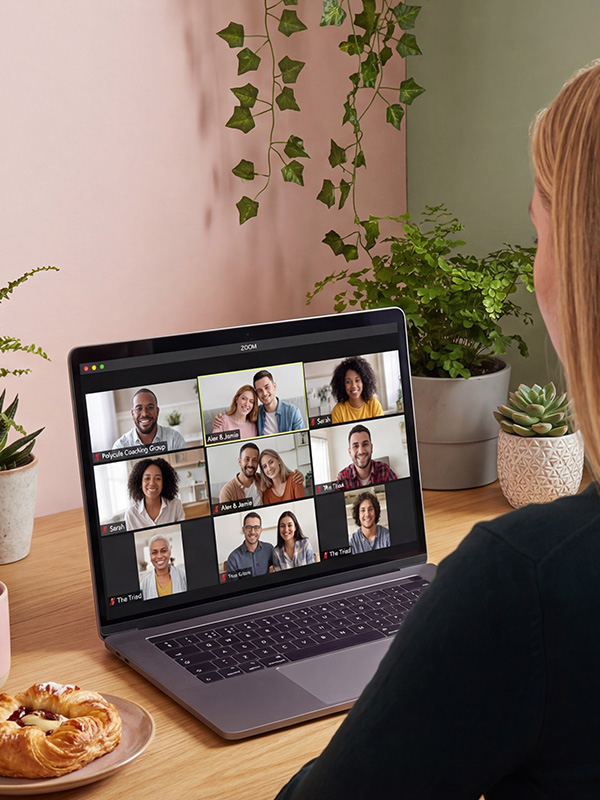
Group coaching programs provide a structured, facilitated environment where participants can explore relationship dynamics alongside others who are navigating similar questions. These programs combine guided discussion, relational education, and practical skill-building exercises that help participants develop healthier communication patterns and deeper relational awareness.
Each program is intentionally designed to create a respectful, confidential space where participants can explore real relationship challenges while learning practical tools grounded in relationship science, communication research, and ethical relational frameworks.
Unlike individual coaching, group coaching allows participants to learn from a wider range of experiences and perspectives. Hearing how others navigate similar situations often creates powerful insight and normalization that can accelerate growth and understanding.
Group coaching also makes relational education more accessible by allowing participants to engage with structured coaching support at a lower price point while still benefiting from high-quality facilitation and thoughtful program design.
Topic-Based Cohorts
Topic-based cohorts bring together a small group of participants who want to explore a specific relationship theme over a series of sessions. These programs may focus on communication skills, attachment patterns, jealousy and insecurity, relational boundaries, or values alignment in relationships.
Participants move through the program together week by week, allowing deeper reflection and accountability as each session builds on the previous one. Cohorts encourage thoughtful discussion, shared learning, and practical application of relational tools in everyday life.
Opening-Up Intensives
Opening-up intensives are designed for individuals or couples who are considering consensual non-monogamy or who are in the early stages of opening a relationship. These focused programs provide guidance for navigating relationship transitions with care, clarity, and intentional communication.
Sessions explore emotional readiness, expectations, boundaries, relational agreements, and common challenges that arise when transitioning from monogamy to ethical non-monogamy. The goal is to help participants approach new relationship structures thoughtfully rather than reactively.
Communication Skill-Building Groups
Communication skill-building groups focus on developing practical tools that help people navigate conflict, express needs clearly, and listen more effectively within their relationships. These sessions introduce evidence-informed communication strategies and guided exercises that participants can practice in real time.
Participants learn frameworks for difficult conversations, emotional regulation during conflict, and collaborative problem-solving that supports stronger and more respectful partnerships.
These group programs and educational workshops are designed for individuals and partners who want to improve communication, strengthen relational skills, and build more intentional relationships.
Participants often include:
Programs are welcoming to people from many relationship structures and identities, including monogamous couples, non-monogamous partnerships, polyamorous relationships, and individuals exploring what relational style works best for them.
Participants in group coaching programs and relationship education workshops can expect a structured, respectful learning environment designed to support reflection and skill development.
Programs typically include:
These programs are designed to help participants move beyond reactive patterns and toward more intentional, informed, and sustainable relationships.
Each program focuses on developing practical skills that participants can continue using long after the sessions have ended.